
Why seed phrases fail teams
Traditional self-custody relies on a single point of failure: one private key, one seed phrase. For institutional teams managing significant capital, this architecture is inherently fragile. The seed phrase is a static secret that, once generated, must be stored, backed up, and protected indefinitely. If that phrase is compromised, lost, or intercepted, the assets are gone. There is no recovery mechanism, no multi-party verification, and no way to revoke access without moving funds to a new, secure wallet.
The operational reality is that human error is the primary vector for loss. Seed phrases are vulnerable to physical theft, digital phishing, and accidental exposure through insecure storage practices like cloud backups or unencrypted files. Even with rigorous protocols, the sheer weight of responsibility placed on a single piece of data creates an unacceptable risk profile for teams that cannot afford downtime or irreversible loss.
Risk Alert: The majority of crypto thefts stem from key management failures, not protocol exploits. Securing the infrastructure is only half the battle; securing the keys is the other.
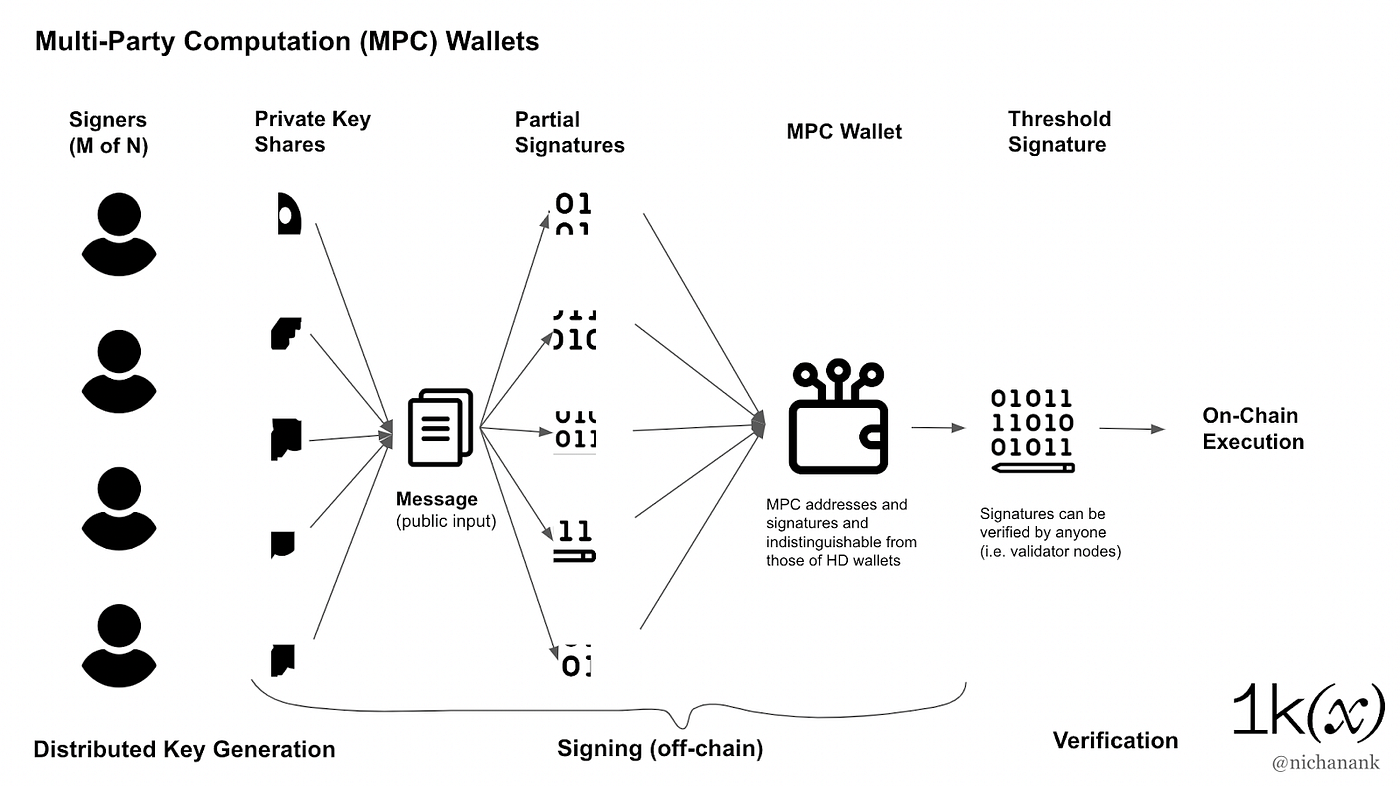
Multi-Party Computation (MPC) addresses this vulnerability by eliminating the single point of failure. Instead of one entity holding the complete private key, MPC splits it into multiple "shards" distributed across different parties. No single party ever has access to the full key, even during transaction signing. This approach transforms security from a static defense into a dynamic, collaborative process, aligning better with institutional risk management standards.
How MPC and AA Work Together
MPC AA wallets resolve the historical trade-off between security and usability by combining Multi-Party Computation (MPC) with Account Abstraction (AA). In this architecture, MPC handles the cryptographic heavy lifting—splitting the private key into shares to prevent single points of failure—while AA manages the user interface through smart contract logic. This synergy allows institutions to maintain strict custody standards without imposing friction on daily operations.
The security layer operates independently of the transaction execution. When a user initiates a transfer, the MPC protocol ensures that no single entity, including the service provider, ever possesses the complete private key. This eliminates the risk associated with seed phrases and centralized key storage. The result is a system where the key never exists in a reconstructable form, significantly reducing exposure to theft or internal compromise.
Simultaneously, Account Abstraction transforms the wallet from a passive key holder into an active smart contract. This enables features like social recovery, batched transactions, and session keys. Users interact with a familiar interface, while the underlying smart contract handles complex authorization rules. The combination means that security is baked into the protocol, and usability is handled by the application layer.
This dual-layer approach is particularly valuable for institutional risk management. By decoupling key security from user interaction, teams can implement granular access controls and multi-signature workflows without sacrificing speed. The wallet becomes a programmable asset that adapts to specific compliance and operational needs.
MPC vs AA vs MPC AA comparison
Use this section to make the MPC AA Wallet decision easier to compare in real life, not just on paper. Start with the reader's actual constraint, then separate must-have requirements from details that are merely nice to have. A practical choice should survive normal use, maintenance, timing, and budget. If a recommendation only works in an ideal situation, call that out plainly and give the reader a fallback path.
| Factor | What to check | Why it matters |
|---|---|---|
| Fit | Match the option to the primary use case. | A good deal still fails if it does not fit the job. |
| Condition | Verify age, wear, and service history. | Hidden condition issues erase upfront savings. |
| Cost | Compare purchase price with likely upkeep. | The cheapest option is not always the lowest-cost option. |
ERC-4337 adoption in 2026
Account Abstraction (ERC-4337) has shifted from experimental infrastructure to the operational backbone for institutional digital asset management. The protocol’s separation of transaction execution from consensus layer validation allows MPC wallets to implement sophisticated, policy-driven authorization flows without altering the underlying blockchain. This decoupling is critical for high-stakes environments where governance, compliance, and risk management must be programmatically enforced.
The maturity of ERC-4337 in 2026 means that AA wallets are no longer limited to consumer-grade convenience features. Instead, they support complex sponsorships, session keys, and multi-factor approval workflows that align with institutional custody standards. By leveraging smart contract accounts, teams can define granular permissions—such as daily transfer limits or mandatory multi-sig approvals—directly into the wallet’s logic. This transforms the wallet from a simple key storage mechanism into a dynamic risk management interface.
For organizations managing significant capital, the ability to customize account logic while maintaining the security benefits of MPC is a decisive advantage. The combination of distributed key shares and programmable execution environments creates a robust framework that mitigates single points of failure while enabling operational flexibility. As the ecosystem solidifies, ERC-4337 remains the primary enabler for deploying institutional-grade AA wallets at scale.
Choosing the right custody setup
Selecting a custody model requires aligning technical architecture with operational risk. The decision hinges on three variables: team size, transaction volume, and institutional risk tolerance. There is no universal standard; the correct setup depends on whether the organization prioritizes maximum control or streamlined efficiency.
MPC AA wallets distribute key shares across multiple parties, removing the single point of failure inherent in seed phrases. This structure suits teams with multiple signers who need to collaborate without exposing the full private key. If your workflow requires multi-party approval for every transaction, this model reduces operational friction while maintaining strict security boundaries.
High-frequency trading desks or treasury operations benefit from automated execution. MPC AA wallets integrate with smart contracts to sponsor gas and batch transactions, reducing costs and latency. For low-volume hold strategies, traditional cold storage may suffice, but for active management, the programmability of MPC AA wallets provides necessary scalability without compromising key security.
Regulatory compliance and audit trails are non-negotiable for most institutions. MPC AA wallets provide immutable logs of key usage and transaction authorization, satisfying strict internal controls. If your risk profile demands granular visibility into who signed what and when, this architecture offers the transparency that offline hardware wallets cannot provide on their own.
| Feature | MPC AA Wallet | Seed Phrase |
|---|---|---|
| Key Exposure | Distributed shares; no single point of failure | Full key held in one location |
| Transaction Speed | High; supports automation and batching | Low; requires manual signing and movement |
| Team Collaboration | Native multi-signer workflow | Difficult; requires secure physical sharing |
| Audit Trail | Immutable smart contract logs | Limited; relies on external records |
No comments yet. Be the first to share your thoughts!