
Why combine MPC and account abstraction
Enterprise custody requires two distinct capabilities: secure key management and flexible transaction logic. Multi-party computation (MPC) and account abstraction (AA) deliver these separately, but combining them creates a hybrid architecture that solves the limitations of using either technology in isolation.
MPC provides the security layer. It splits the private key into multiple shares distributed across different devices or servers. No single party holds the complete key, eliminating the single point of failure found in traditional wallets. If one device is compromised, the attacker cannot sign transactions or steal assets without the other shares. This makes MPC ideal for enterprise teams that need to enforce multi-signature policies and reduce operational risk.
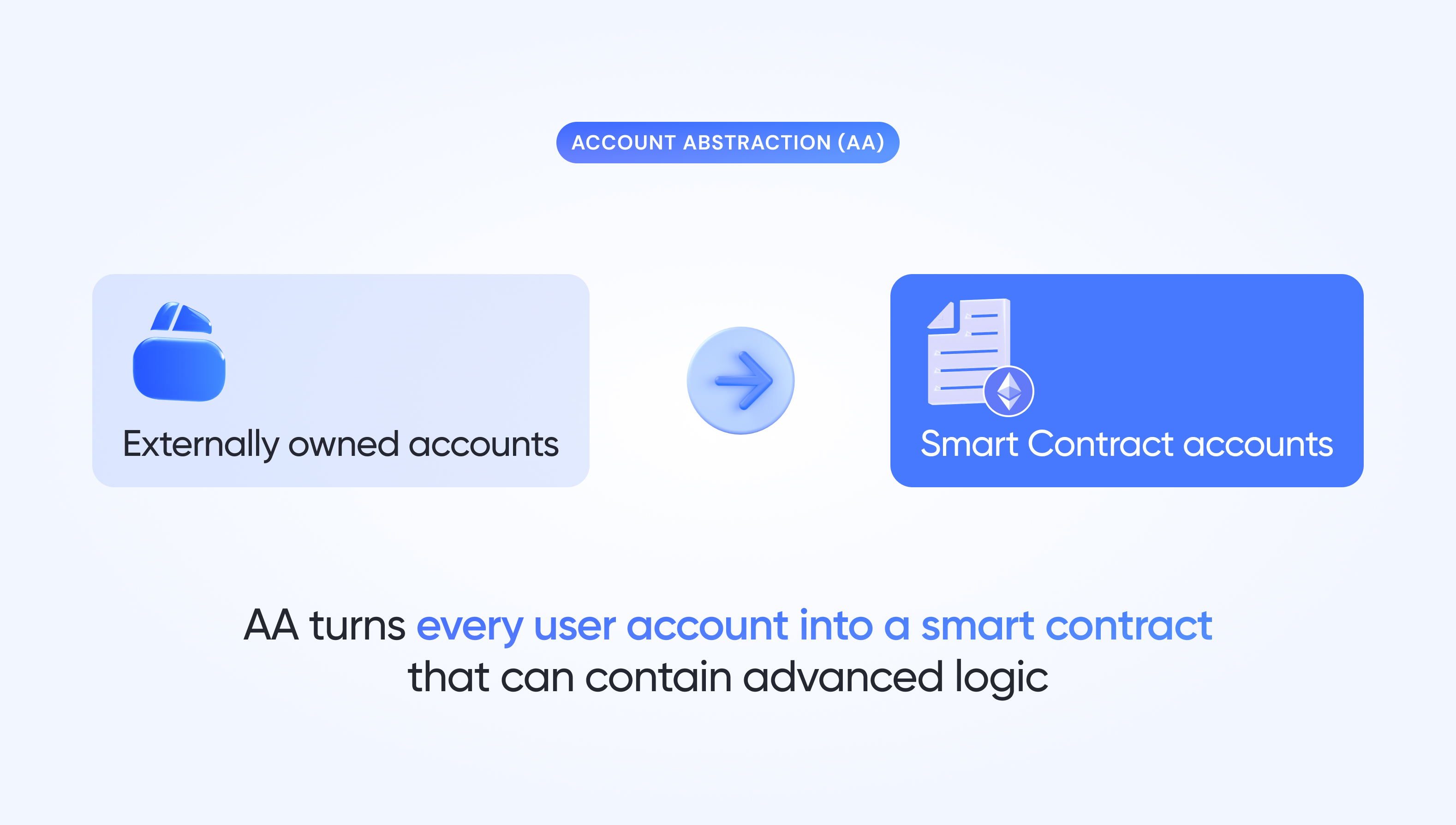
AA provides the user experience layer. It replaces the traditional externally owned account (EOA) with a smart contract wallet. This allows for features like gasless transactions, social recovery, and programmatic transaction logic. For enterprise workflows, AA means transactions can be batched, validated against custom rules, and executed without the user needing to hold native tokens for fees.
When combined, the MPC engine signs the transactions generated by the AA smart contract. The private key never leaves the secure MPC network, while the AA contract manages the flow of assets and user interactions. This separation of concerns allows enterprises to build custodial solutions that are both secure and intuitive for end users.
Mpc vs aa: security and ux choices that change the plan
Standalone MPC and standalone AA solve different halves of the custody problem. MPC focuses on security by splitting keys, while AA focuses on user experience by replacing keys with smart account logic. Neither approach alone is sufficient for enterprise-grade security without sacrificing usability.
Standalone MPC: Security without Friction
Multi-Party Computation (MPC) eliminates the single point of failure inherent in traditional wallets. Instead of storing one private key, the system splits it into shards distributed across different devices or servers. This architecture prevents any single compromised device from stealing assets, making it ideal for institutional custody.
However, standalone MPC often lacks the flexibility users expect from modern wallets. It handles the "how" of signing securely but doesn't inherently manage the "who" or "when" of access. Users may still face complex onboarding flows or rigid signing requirements that don't adapt to corporate governance needs.
Standalone AA: Experience without Custody
Account Abstraction (AA) transforms the wallet into a smart contract account. This allows for features like social recovery, batched transactions, and session keys, significantly improving the user experience. Users can recover access via email or friends rather than a cryptic seed phrase, lowering the barrier to entry.
The tradeoff is that standalone AA typically relies on a single private key for initial control or recovery. If that key is lost or stolen, the account logic offers limited protection against unauthorized transfers. It simplifies interaction but doesn't inherently distribute trust or prevent key compromise.
Comparison: Security vs. Experience
The table below outlines the core differences between these standalone approaches to highlight why a hybrid model is necessary for enterprise custody.
| Feature | MPC Only | AA Only |
|---|---|---|
| Key Management | Sharded across multiple parties | Single private key or seed |
| Recovery | Complex threshold signing | Social or email-based recovery |
| Threat Model | Mitigates single device loss | Mitigates user error/loss |
| Enterprise Governance | Hard to implement policy logic | Easy to implement policy logic |
How MPC AA wallets split and sign keys
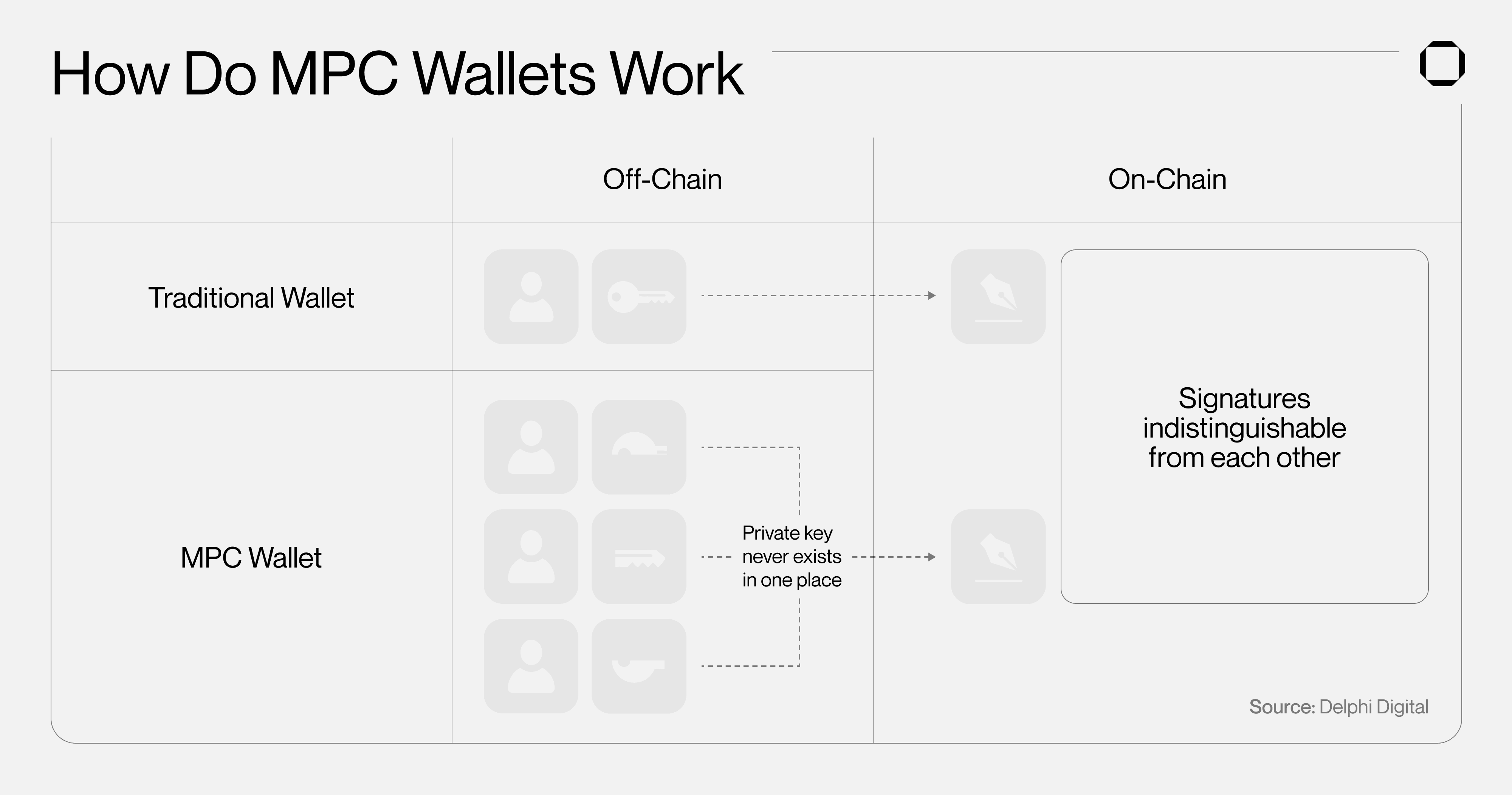
An MPC AA wallet removes the single point of failure inherent in traditional custody. Instead of storing one private key, the system splits it into multiple shards using Shamir’s Secret Sharing. These shards are distributed across different devices or servers. No single party ever holds the complete key.
When a transaction needs to be signed, the process follows a strict sequence. The user initiates the request, and the Account Abstraction (AA) smart contract first validates the transaction against predefined rules. Only after these rules pass do the MPC parties generate their partial signatures. These partial signatures are then aggregated on-chain to produce a valid transaction signature.
The user or an automated system initiates a transaction. This triggers the AA smart contract, which acts as the gatekeeper. The contract checks if the transaction meets all policy requirements, such as spending limits or time locks.
The AA contract validates the transaction against the stored signing policy. If the rules are not met, the transaction is rejected immediately. This step ensures that even if a shard is compromised, it cannot be used to bypass institutional controls.
Once validated, the MPC protocol engages. Each party holding a shard generates a partial signature. These partial signatures are mathematically derived from the shard and the transaction data. No party reveals their shard to the others.
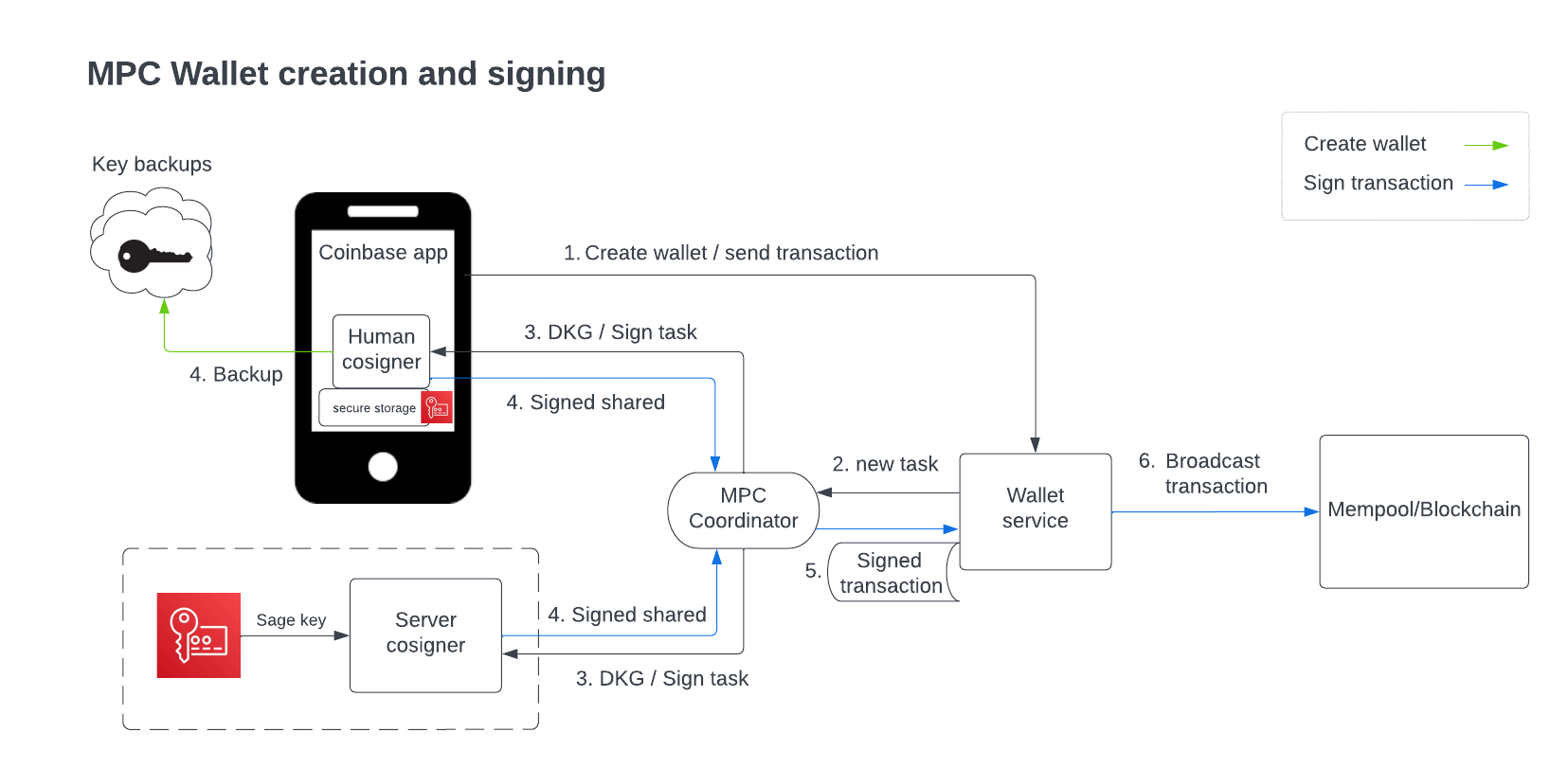
The partial signatures are sent to the blockchain. The AA contract or a relayer aggregates them into a single valid signature. This signature authorizes the transaction, completing the custody process without any single entity ever possessing the full private key.
Setting up an MPC AA wallet for your team
Deploying an MPC AA wallet requires bridging two distinct technologies: Account Abstraction (AA) for flexible, user-friendly transaction logic, and Multi-Party Computation (MPC) for distributed key security. Unlike traditional wallets where a single private key is a single point of failure, MPC splits that key into shares distributed across multiple parties. When combined with AA smart contracts, your team gains the ability to define custom signing thresholds and recovery flows without sacrificing security.
Before writing code, determine how your team will interact with the wallet. Decide on the number of signers required for different transaction types. For example, small daily expenses might require one signature, while large institutional transfers require three. These policies will dictate how the smart contract is configured and how the MPC protocol is initialized.
Choose an MPC infrastructure provider that supports the specific signature schemes required by your blockchain network. Integrate their SDK into your backend services. This step establishes the secure channel between your application and the key generation servers, ensuring that no single entity ever holds the complete private key.
Deploy your Account Abstraction wallet contract on the target chain. Configure the contract to accept signatures generated by your chosen MPC provider. This contract acts as the on-chain guardian, verifying that the MPC-generated signatures meet your predefined policy rules before allowing any asset movement.

Set up the key generation ceremony for your team members. Each user’s device or server will receive a unique key share. Ensure your onboarding flow securely distributes these shares and verifies the integrity of the participants. This step establishes the initial trust anchor for the wallet.
Run end-to-end tests simulating real-world scenarios. Verify that transactions are signed correctly when different combinations of signers are available. Test edge cases, such as a signer going offline, to ensure the MPC protocol and AA contract handle failures gracefully without locking assets.
When to choose an MPC AA wallet
An MPC AA wallet is the right choice when your organization needs to balance institutional-grade security with the flexibility required for modern digital asset operations. It is not a replacement for all custody solutions, but it is the standard for entities that move funds frequently or require complex, multi-party authorization workflows.
Corporate treasuries managing digital assets
Traditional custodial solutions often struggle with the speed and programmability required by active treasury operations. An MPC AA wallet allows your finance team to execute transactions without waiting for physical hardware keys or manual key transfers. The private key is never reconstructed in one place, eliminating the single point of failure inherent in traditional cold storage while maintaining the security controls auditors require.
DAO treasuries and multi-signature governance
Decentralized organizations operate with distributed teams and transparent governance. MPC AA wallets integrate with on-chain governance frameworks, allowing proposals to trigger automated transaction signing. This reduces the friction of executing approved decisions while ensuring that no single individual can unilaterally drain the treasury. The "AA" (Account Abstraction) layer further simplifies this by allowing smart contract-based recovery and batched transactions.
High-volume fintech and payment processors
If your business processes payments for thousands of users, the overhead of managing individual private keys is unsustainable. MPC AA wallets provide a unified interface for managing user funds at scale. The architecture allows you to offload key management to the MPC network, letting your engineers focus on building the user experience rather than securing cryptographic shards.
Hybrid custody models
Some enterprises require a mix of hot and cold storage for different risk profiles. MPC AA wallets offer the flexibility to define custom signing policies. You can configure which transactions require multi-party approval and which can be executed automatically based on predefined thresholds, creating a custody solution that adapts to your specific risk appetite.
How MPC wallets work and differ from standard wallets
Traditional wallets store a single private key as a file or string of text. If that key is compromised, the assets are lost. MPC wallets eliminate this single point of failure by breaking the private key into multiple shares using secret sharing schemes like Shamir's Secret Sharing. These shares are distributed across different devices, servers, or parties. No single party ever holds the complete key, ensuring that even if one component is stolen, the assets remain secure.
The difference between MPC and non-MPC wallets comes down to this distribution. Non-MPC wallets rely on one key location, while MPC technology splits responsibility. This architecture allows for more flexible security models, such as requiring multiple approvals for large transactions or recovering access without a single master key.
No comments yet. Be the first to share your thoughts!