
Why combine MPC and account abstraction
Enterprise security requires more than just preventing theft; it demands operational efficiency. Combining Multi-Party Computation (MPC) with Account Abstraction (AA) addresses the two primary friction points in institutional crypto: key management and transaction complexity.
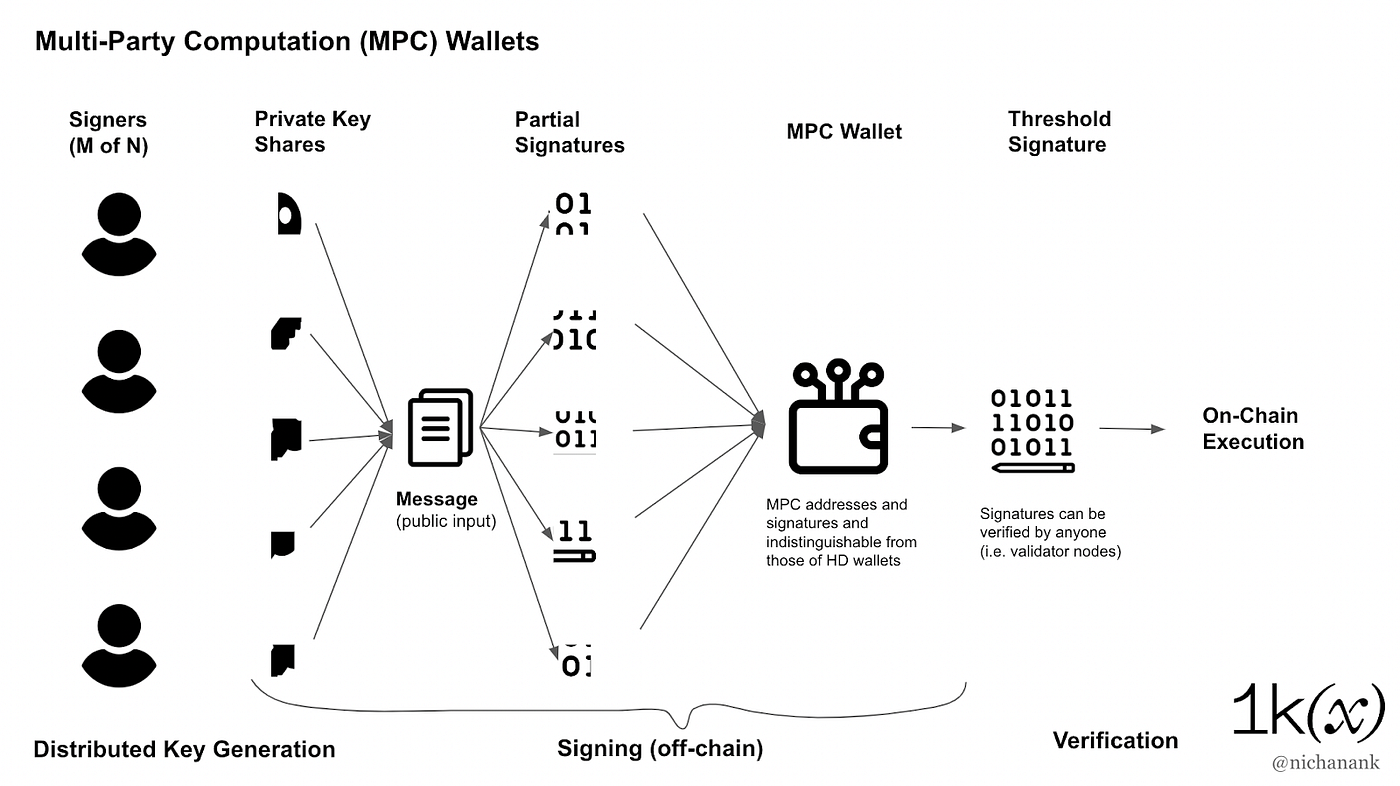
MPC eliminates the single point of failure inherent in traditional wallets by splitting private keys into distributed shares. No single entity or server ever holds the complete key. This structure significantly reduces the risk of total loss from theft or misplacement, as attackers must compromise multiple independent nodes to authorize a transaction.
Account abstraction shifts the wallet from a static storage device to a smart contract. This enables features like gasless transactions, batched operations, and social recovery. For enterprises, this means employees can transact without managing separate gas tokens, and lost devices can be recovered through trusted contacts rather than complex seed phrase backups.
Together, these technologies create a wallet-as-a-service architecture that is both secure and user-friendly. MPC handles the heavy lifting of cryptographic security, while AA provides the flexibility needed for modern enterprise workflows. This combination allows organizations to achieve mass adoption of Web3 assets without compromising on institutional-grade security standards.
Compare MPC and AA wallet architectures
Standalone Multi-Party Computation (MPC) and standalone Account Abstraction (AA) wallets solve different problems. MPC focuses on cryptographic security by splitting private keys, while AA focuses on user experience and transaction flexibility through smart contract logic. Understanding the distinction is essential before selecting a hybrid architecture for enterprise use.
Standalone MPC wallets
MPC wallets distribute private key shares across multiple parties or devices. No single entity holds the complete key, which eliminates the risk of a single point of failure. Transactions are authorized through collaborative cryptographic computation, requiring consensus among key holders.
This architecture excels in security. It prevents theft from device compromise and offers advanced recovery options if a key share is lost. However, standalone MPC wallets often sacrifice user experience. The signing process can be slow and complex, requiring coordination between multiple parties for every transaction.
Standalone AA wallets
AA wallets, also known as smart contract wallets, replace the traditional Externally Owned Account (EOA) with a smart contract. This allows for features like social recovery, session keys, and gas sponsorship. Users interact with the wallet through a familiar interface, while the smart contract handles complex logic behind the scenes.
The primary advantage of AA is flexibility. It enables account recovery without seed phrases and allows for batch transactions. However, standalone AA wallets still rely on a single private key for signing. If that key is compromised, the entire account is vulnerable, lacking the distributed security of MPC.
Side-by-side comparison
The following table contrasts the core features of standalone MPC, standalone AA, and the hybrid MPC+AA approach recommended for enterprise security.
Set up the MPC key generation process
Generating an MPC AA wallet begins with a secure key generation ceremony. Unlike traditional wallets that store a single private key, Multi-Party Computation (MPC) splits the key into multiple shards. No single entity ever holds the complete private key. This distribution ensures that even if one guardian is compromised, the funds remain secure.
1. Define the threshold and participant set
Before generating any keys, establish the security parameters. You must determine the number of guardians (nodes) and the threshold required to sign a transaction. For enterprise environments, a common configuration is 2-of-3 or 3-of-5. This means any two or three guardians must collaborate to authorize a transfer. Define these roles clearly in your smart contract or key management service configuration.
2. Execute the distributed key generation (DKG) protocol
Initiate the DKG protocol among the selected guardians. Each participant generates a random secret share locally. Through a series of cryptographic exchanges, these shares are combined to create the public key associated with the wallet address. The private key is never assembled in one place; it remains mathematically fragmented across the network. This process typically relies on verifiable secret sharing schemes to ensure no participant can cheat or withhold their share.
3. Distribute and verify key shares
Once the public key is established, distribute the private key shares to each guardian securely. Each guardian receives only their specific shard. It is critical to verify that each share is valid and corresponds to the agreed-upon public key. Use cryptographic proofs to validate integrity without revealing the share itself. Store these shares in hardware security modules (HSMs) or secure enclaves to prevent extraction.
4. Test with a threshold signature
Perform a test transaction to validate the entire setup. Initiate a small transfer that requires the threshold number of guardians to sign. Monitor the communication between nodes to ensure the signature shares are generated and combined correctly. If the transaction fails, check for network latency issues or misconfigured threshold parameters. Only proceed to mainnet use after successful testnet validation.
Wrap MPC transactions in an ERC-4337 smart contract
To turn a standard MPC signing process into a full enterprise-grade wallet, you must deploy an ERC-4337 compliant smart contract. This contract acts as the on-chain identity that receives and executes the signatures generated by your MPC nodes. By decoupling the signing logic from the execution logic, you enable advanced features like paymasters and session keys that are impossible with simple key management.
1. Deploy the ERC-4337 Account Contract
Begin by deploying a minimal ERC-4337 compatible account contract (such as SafeWallet or a custom implementation). This contract will serve as the entry point for all transactions. Ensure the contract includes the required executeUserOp and validateUserOp functions, which are standard for bundler compatibility.
2. Implement Signature Validation Logic
The smart contract must verify that incoming transactions are authorized. Instead of checking a standard ECDSA signature against a single public key, implement a custom validation module that accepts the MPC threshold signature. The contract should verify that the signature corresponds to the distributed key shares held by your MPC nodes, ensuring only authorized parties can trigger transactions.
3. Integrate Paymaster Support
To improve user experience, integrate a paymaster contract. This allows the enterprise to sponsor gas fees for specific operations or subsidize costs for end-users. The ERC-4337 standard allows the paymaster to validate the user operation before execution, enabling flexible billing models like corporate expense accounts or sponsored onboarding.
4. Configure Session Keys for Limited Access
Implement session keys within the smart contract to grant temporary, limited permissions to third-party applications. Unlike full private keys, session keys can be restricted by time, value limits, or specific contract addresses. This reduces the attack surface for enterprise applications that need to interact with the wallet on behalf of users without holding full control.
5. Test with a Bundler
Finally, test the integration using an ERC-4337 bundler. Send a user operation through the bundler to ensure the smart contract correctly validates the MPC signature and executes the transaction. Verify that the paymaster and session key logic functions as expected under real network conditions.
Deploy a minimal ERC-4337 compatible account contract (such as SafeWallet or a custom implementation). This contract will serve as the entry point for all transactions. Ensure the contract includes the required executeUserOp and validateUserOp functions, which are standard for bundler compatibility.
The smart contract must verify that incoming transactions are authorized. Instead of checking a standard ECDSA signature against a single public key, implement a custom validation module that accepts the MPC threshold signature. The contract should verify that the signature corresponds to the distributed key shares held by your MPC nodes, ensuring only authorized parties can trigger transactions.
To improve user experience, integrate a paymaster contract. This allows the enterprise to sponsor gas fees for specific operations or subsidize costs for end-users. The ERC-4337 standard allows the paymaster to validate the user operation before execution, enabling flexible billing models like corporate expense accounts or sponsored onboarding.
Implement session keys within the smart contract to grant temporary, limited permissions to third-party applications. Unlike full private keys, session keys can be restricted by time, value limits, or specific contract addresses. This reduces the attack surface for enterprise applications that need to interact with the wallet on behalf of users without holding full control.
Finally, test the integration using an ERC-4337 bundler. Send a user operation through the bundler to ensure the smart contract correctly validates the MPC signature and executes the transaction. Verify that the paymaster and session key logic functions as expected under real network conditions.
Deploy and test the hybrid wallet
Before moving your MPC AA wallet to mainnet, you must verify the smart contract deployment and validate the signing flow on a testnet. This phase ensures that the threshold signature logic and account abstraction features function as intended under real network conditions.

Deploy your wallet smart contract to a testnet like Sepolia or Goerli. Use a tool like Hardhat or Foundry to automate the deployment process. Ensure the contract is verified on the block explorer so you can inspect the bytecode and source code publicly. This step confirms that the contract logic is correctly compiled and deployed.
Connect your smart contract to your MPC node provider. Configure the threshold parameters (e.g., 2-of-3) and ensure the key shares are distributed correctly among the designated parties. Test the key generation process to confirm that no single party holds the complete private key, which is the core security feature of MPC wallets.
Send small test transactions from the wallet to verify the signing flow. Check that the MPC nodes collaborate to produce a valid signature that the smart contract accepts. Test both standard transfers and ERC-4337 account abstraction features, such as paymasters and bundlers, to ensure the hybrid model works end-to-end.
Intentionally trigger failure scenarios to test the wallet's resilience. Simulate node failures, network timeouts, and invalid signatures. Verify that the system correctly rejects invalid transactions and that the key recovery mechanism works if a share is lost or compromised. This step is critical for ensuring enterprise-grade reliability.
Once these tests pass, you can proceed to mainnet deployment with confidence. Ensure you have a monitoring plan in place to track signing latency and transaction success rates from day one.
No comments yet. Be the first to share your thoughts!